Give an unfamiliar writer ten minutes. You may read them for years.
There is no shortage of books, and that may actually be part of the problem.
Independent writers now have access to publishing and distribution tools that would have been unimaginable not that many years ago. A book can reach readers around the world without first passing through the traditional publishing gatekeepers. What has not become easier is discovery.
An unfamiliar author is still asking a reader to make a surprisingly large commitment. Buy this book. Read this sample. Trust this review. Believe this advertisement. Spend several dollars—and, perhaps more importantly, several hours—to find out whether this is a writer whose work you want to continue reading.
I started wondering whether we have been approaching that problem backwards. What if the first thing we gave readers wasn’t an advertisement? What if we simply gave them the writing?
That question became 10 Minutes To…
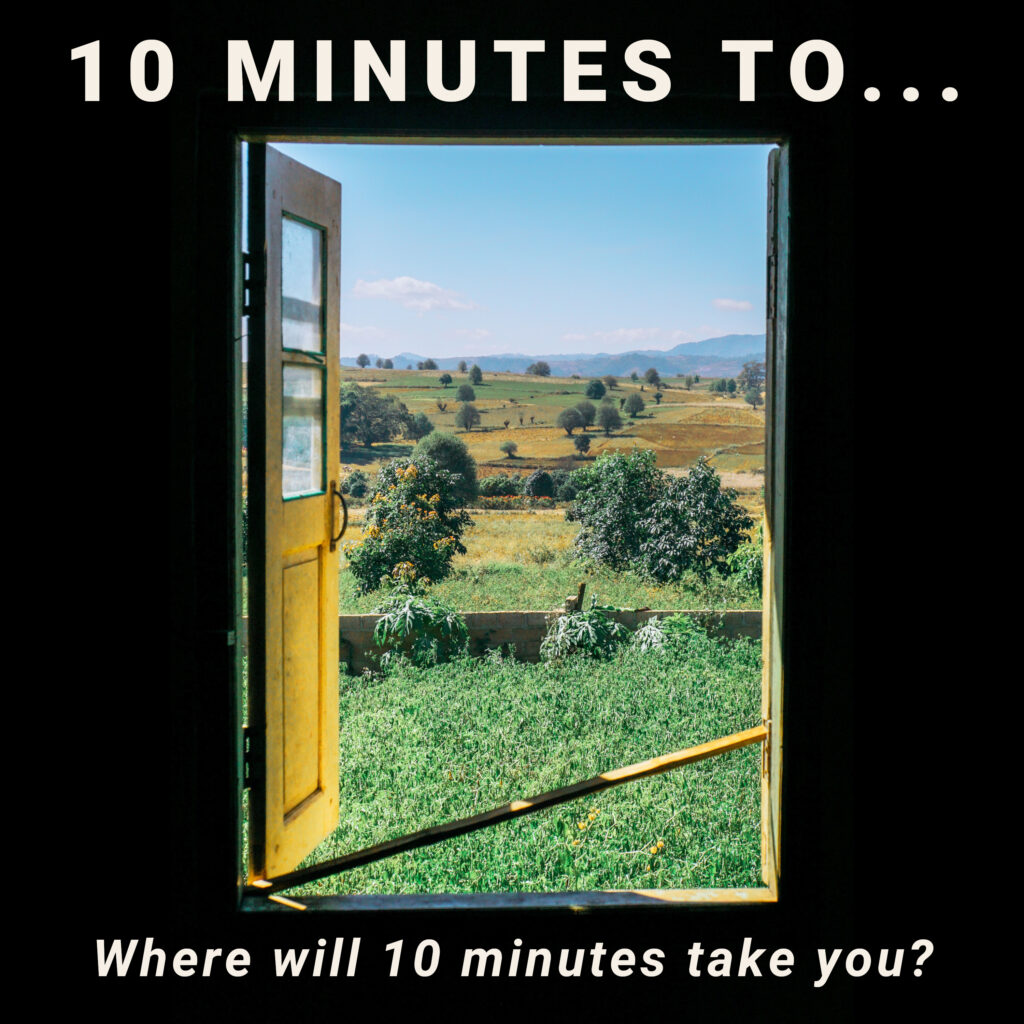
Cover artwork for 10 Minutes To… Base photograph by Clive Kim via Pexels. Photograph modified and incorporated into the cover design.
Ten minutes is enough to find out if something connects
The premise is deliberately simple. Each episode of 10 Minutes To… introduces one indie writer through one human-narrated piece of fiction lasting ten minutes or less.
That piece might be a complete short story, an excerpt that works on its own, a prequel, a side story, a character moment, an alternate point of view, or something written specifically to introduce listeners to the author’s world. The important part isn’t where the piece came from. It is what happens during those few minutes.
Does the voice catch your attention? Does the world make you curious? Do you want to know what happens next? Do you finish thinking, I want to read more from this person?
If the answer is no, the listener has lost no more than ten minutes. If the answer is yes, those ten minutes may have introduced them to an author they continue reading for years.
That is the experiment at the heart of the project.
This isn’t an audiobook sampler
I don’t want 10 Minutes To… to become a catalogue of authors reading the first ten minutes of their novels. Sometimes the opening of a novel will be exactly the right submission, but often it won’t.
A musician trying to introduce you to their work doesn’t generally give you the first three minutes of an album and stop when the timer runs out. They give you a song. That is closer to how I hope authors will think about this project.
The question shouldn’t be, “What ten minutes can I cut out of my book?”
It should be, “What can I give someone in ten minutes that might make them want another encounter with my writing?”
Sometimes that will be an excerpt. Sometimes it might be a complete piece of flash fiction, a short story connected to a larger work, a prequel, or something created specifically for this kind of discovery. Sometimes the right piece may take only four minutes.
Ten minutes is the ceiling, not a target that has to be filled.
Why audio?
Reading isn’t the only time people can discover stories. People listen while driving, cooking, walking, working around the house, sitting on a bus, or doing any number of other things.
Audio also allows 10 Minutes To… to live on platforms people already use. The series will be distributed through Spotify and YouTube, with the YouTube editions using simple, non-distracting visual backgrounds rather than attempting to turn each piece into a film. The story remains the focus, the narration is human, and the visual stays out of its way.
There is another reason Spotify and YouTube became central to the idea, though: playlists.
The catalogue doesn’t have to be organized only by us
The official 10 Minutes To… catalogue will be curated, and stories may appear in playlists built around familiar genres such as speculative fiction, science fiction, fantasy, mystery, romance, horror, thriller, literary fiction, environmental fiction, and others.
But genre is only one way people decide what they want to experience.
A story might also appear in collections such as Canadian Authors, Alberta Authors, Artificial Intelligence, Environmental Fiction, Hopeful Futures, Stories Set in Canada, Young Adult, Something Strange, or Five Minutes or Less.
One episode can have many paths leading to it.
More importantly, the official playlists are only the beginning. Spotify and YouTube give their users the ability to build their own playlists from the material they find there. That means 10 Minutes To… doesn’t get to decide the only way the catalogue is explored.
Readers can curate their own collections. Authors can create playlists of writers they admire. Reviewers, book bloggers, librarians, book clubs, and other readers can assemble collections around themes or interests that may never have occurred to us.
Someone might create Ten Indie Climate-Fiction Writers You Should Hear, Short Fiction That Left Me Thinking, My Favourite Canadian Indie Writers, or simply Stories I Loved.
An author whose own work appears in the catalogue might create a playlist that includes their piece alongside other writers they want their readers to discover. A reader might encounter one author through an official Science Fiction playlist, save the episode, and months later find another writer through a completely different collection created by somebody else.
That possibility is important because the individual recording doesn’t have to live and die with its publication announcement. The catalogue remains while the playlists continue to change.
That’s the part borrowed from music discovery
The idea behind 10 Minutes To… isn’t to turn books into music. It is to borrow something music platforms have become very good at: letting people discover creators before they are asked to make a larger commitment.
You hear a song, add it to a playlist, encounter another playlist someone else created, and suddenly an artist you’ve never heard of becomes familiar.
Books often work in the opposite direction. We begin by showing someone a cover, a description, a price, and a purchase button. Only after all of that do they actually experience the writing.
10 Minutes To… reverses the order.
Experience the writing first. If it connects, we’ll show you where to find the author’s book, series, website, or other chosen destination.
There is no sales pitch before the story and no requirement to buy anything. The listener simply gets an opportunity to find out whether this writer is for them.
For indie authors, there is no table to buy
Another part of the project matters just as much to me: there is no fee to submit and no fee to participate.
Indie authors are routinely offered opportunities to purchase visibility through advertising, promotional packages, festival tables, features, listings, campaigns, and any number of other services. Some are useful and some aren’t, but almost all of them ask the author to spend money before anyone knows whether a reader will actually care about the work.
I wanted to remove that part of the equation.
Authors selected for 10 Minutes To… provide their writing and a clean human-narrated recording. That recording does not become exclusive to the project. Authors remain free to use it on their own websites, social channels, newsletters, podcasts, or elsewhere, and they retain copyright in their work.
What 10 Minutes To… receives is the continuing permission necessary to keep that published episode in the catalogue and allow it to remain part of the discovery system over time.
That permanence matters. A useful catalogue cannot function if pieces continually disappear because an author later decides they dislike a playlist, another contributor, or where their episode happens to sit within a collection.
Authors can suggest genres, themes, moods, geographic categories, and other classifications when they submit. Final curation of the official 10 Minutes To… playlists remains editorial. Readers and authors, however, remain free to build their own playlists on the platforms themselves.
The distinction is simple: we curate the official shelves; everyone else is free to build their own.
Human voices, deliberately
Every recording in 10 Minutes To… will be narrated by a human being. The narrator can be the author or another human narrator the author has permission to use.
It also doesn’t need to come from an expensive studio.
Good audio matters, but participation shouldn’t require hundreds or thousands of dollars in production costs. A quiet room, a reasonable microphone, and free open-source software such as Audacity can produce perfectly usable spoken-word audio.
We are deliberately keeping the recordings simple as well. There is no background music, no sound effects, and no elaborate audio production. That keeps the focus where it belongs and avoids creating unnecessary rights and copyright complications.
The writing and the human performance should be enough.
What kinds of books?
A lot.
Science fiction, speculative fiction, fantasy, environmental fiction, climate fiction, horror, mystery, thriller, romance, historical fiction, contemporary fiction, literary fiction, adventure, humour, young adult fiction, and work that refuses to fit neatly into any of those boxes all have a place in the conversation.
I’m equally interested in categories bookstores don’t necessarily treat as shelves of their own: Canadian Authors, Environmental Fiction, Indigenous Futures, Artificial Intelligence, Hopeful Stories, Stories About Water, Something Weird, Something Quiet, or Something That Will Leave Me Thinking.
The eventual catalogue should reflect how people actually look for stories, not merely the categories publishing has traditionally assigned to them.
That flexibility is one of the reasons the playlist model interests me so much. A single piece can be speculative fiction, environmental fiction, Canadian, hopeful, young adult, and under seven minutes at the same time. There is no reason it should have to choose only one identity.
We’re building the first catalogue now
Right now, 10 Minutes To… is at the beginning. The Spotify show exists, the YouTube home is being prepared, and the website, submission process, recording guidance, discovery categories, and contributor terms are in place.
What we don’t yet have is the most important part: the writers.
So the first invitation is going out to indie authors.
If you have a piece of fiction that can give someone a genuine experience of your writing in ten minutes or less, I would like to hear it. It doesn’t need to come from a bestseller, and you don’t need a huge social following or professional audiobook production. You certainly don’t need to buy your way into the catalogue.
You need a piece of writing worth hearing and a clean human performance of it.
That’s where this starts.
As the catalogue grows, the reader side of the project will grow with it. Official playlists will develop around the stories that arrive, authors and readers will begin building collections of their own, and individual pieces will have opportunities to keep circulating long after their original publication date.
Later, when the catalogue opens fully to listeners, the invitation becomes much simpler:
Give an unfamiliar writer ten minutes and see what happens.