Short Fiction | Lawrence Nault
Sometimes the stories within a novel exist beyond its pages.
In The Aberration Hypothesis, there is a reference to a story about a whale communicating at a frequency unlike those of other whales. That story was not invented simply for the novel. I actually wrote it in early 2025.
Frequencies was originally intended to be published before the release of The Aberration Hypothesis. Unfortunately, those plans fell through.
With the novel now available, I’ve decided to publish the story here in my journal.
Inspired by the real mystery of the 52-hertz whale, Frequencies is a story about voices, understanding, and the distance between speaking and being heard.
The story stands entirely on its own. You don’t need to have read The Aberration Hypothesis to enjoy it.
I hope you enjoy Frequencies.
Frequencies
By Lawrence Nault
Shrill…
Critics had called her and others like her shrill and out of sync with the world among other things like vile and pathetic. She didn’t think she was shrill, though. She thought of her voice as the pedal drone of a bagpipe, quiet in her confidence that when the melody and chorus joined her, it would be a beautiful song.
Doctor Sarah Martinez was reading the heavily critical responses to her recent presentation. She remembered the confidence with which she presented early climate modelling data showing ocean warming. She had spent many hours rehearsing that presentation, ensuring that her voice was measured and scientific, even though her conclusions were radical for the time. As she rehearsed, she decided to mention in passing that her hydrophone data had shown “some interesting acoustic anomalies,” as relief from her data-heavy presentation.
The response at the conference was measured and respectful, but most dismissed her findings as “interesting but premature.” She was surprised that no one had asked about the acoustic anomalies, but then, things that were out of frequency with everything else were often ignored as anomalies.
The responses in journals and in media were far less kind, and it was these responses that led to Dr. Martinez sitting in a conference room that smelled of burned coffee and the faint mustiness of old textbooks. Sarah sat at the polished oak table, her research folder crisp and organized before her, while the afternoon light slanted through blinds that hadn’t been cleaned in months. Dr. Henley drummed his fingers against his mug in a steady, irritating rhythm that seemed to underscore everything wrong with this meeting.
“Your methodology is sound, Dr. Martinez,” he began, and she could already hear the but forming in the pause that followed. “The data collection is exemplary. Really, some of the finest work I have seen.”
Professor Williams nodded from across the table, her reading glasses reflecting the fluorescent light. “The temperature measurements, the statistical analysis are all impressive. The time spent on the 52-hertz hydrophone data, a little out of scope and unnecessary.”
Dr. Martinez felt the familiar tightness in her chest, the way her breath grew shallow when she sensed the conversation turning. She’d been here before, in smaller versions of this moment. The praise that felt like a setup.
“But,” Dr. Henley continued, right on schedule, “the conclusions you’re drawing …” He gestured vaguely at her report. “Three degrees of warming by 2050? Ocean pH changes that could collapse entire food chains? Dr. Martinez, the projections are …”
“They’re what the data show.” Her voice came out steadier than she felt. “I’ve run the models twelve different ways. The margin of error doesn’t change the fundamental trend.”
“The fundamental trend,” Williams repeated slowly, “suggests civilizational collapse within decades. Do you understand how that sounds?”
Dr. Martinez looked around the table. Five tenured professors, all brilliant in their own right, all staring at her with expressions that ranged from concerned to openly skeptical. She felt suddenly very young, very alone, like she was speaking a language only she understood.
“It sounds alarming because it is alarming.” She opened her folder, though she knew they’d all received copies. “The feedback loops are accelerating faster than we predicted even five years ago. The ice sheet data alone …”
“That’s exactly the problem.” Dr. Chen leaned forward, his voice gentle but firm. “Dr. Martinez, you’re a scientist, not an activist. When you present data like this, with language like ‘civilizational collapse,’ you sound like one of those radical activists standing on a street corner with a sign. Not only that. You put funding at risk for all our research.”
“What would you have me say? That everything is fine when it isn’t?”
“We’d have you present the science without the editorializing,” Henley said. “Temperature increase, yes. Ocean acidification, certainly. But apocalyptic scenarios? That’s not our job. Our job is to provide policymakers with objective information.”
“This is objective information.”
Williams removed her glasses, cleaning them slowly. “Dr. Martinez, the department has to consider its reputation. We’re up for a major NSF grant renewal next year. If we’re seen as … alarmist, it could impact our funding.”
The word hung in the air like smoke. Alarmist. As if being alarmed by alarming data was a character flaw rather than a reasonable response. Were they even hearing her words, or just intentionally generating a counter-tone to drown her out?
“So, you want me to what? Soften the conclusions?”
“We want you to present them in context,” Chen said. “Acknowledge the uncertainties. Discuss alternative interpretations. Let others draw the bigger conclusions.”
Dr. Martinez felt something shift inside her chest, a frequency change so subtle she almost didn’t notice it. For three years, she’d been trying to harmonize with their expectations, to make her voice blend with the comfortable drone of academic discourse. But the data was screaming, and they wanted her to whisper.
“The uncertainties are in my methodology section. Twenty-three pages of them.” She kept her voice level, professional. “But uncertainty about the exact timing doesn’t change the direction.”
Henley sighed, the sound of a man who’d already made up his mind. “Dr. Martinez, you’re brilliant. Everyone in this room knows that. But science advances through measured steps, not dramatic leaps. You know you have my full support, but the tenure committee needs to see someone who can build a sustainable research program, not someone who’s going to spend the next thirty years crying wolf.”
Crying wolf. She almost laughed at the absurdity of it. As if wolves weren’t real. As if they weren’t already at the door.
“What if the wolf is actually coming?”
Williams put her glasses back on, the gesture somehow final. “Then we’ll deal with it when we have more advanced evidence. Not before.”
Sarah almost drew blood biting her lip. It wasn’t the first time she had butted heads with Williams, who had a reputation for undermining others so her own protégés would get tenure first.
The meeting ended with handshakes and reassurances that her research was valuable, that there might be other opportunities, that she shouldn’t take this personally. Dr. Martinez smiled and nodded and gathered her papers, playing the part expected of her. But as she walked back to her cramped office, she realized something had changed.
In her desk drawer, beneath a stack of grant applications, sat three years’ worth of hydrophone recordings from her ocean monitoring sites. Deep, consistent sounds that had been running in the background of all her temperature measurements. She’d noted them in her reports but never focused on them. They were just part of the acoustic landscape, calling out at frequencies that seemed to belong to nothing else in the vast, warming sea.
That night, she stayed late and played them back, those steady signals at 52 hertz. A voice in the ocean, constant and alone, singing the same song year after year to an audience that couldn’t hear it.
She understood the feeling.
Those recordings became a backdrop in her office as, over two decades, she pored over data that became more urgent, confirming her earlier predictions. She had not remained silent over those decades, despite the constant threat to her position and the admonishments of her fellow researchers. She had joined activist groups, written op-eds, submitted papers to peer-reviewed journals, and even testified before Congress.
Despite rock-solid data, the characterizations of her as shrill, emotional, and unscientific not only continued but increased exponentially the more she was heard. Other scientists began seeing the patterns, but the institutions resisted change, and Dr. Martinez found her career stalled and relationships strained as she was labeled as “difficult.”
There were times, like this night, that she contemplated walking away from it all. It was that lone call at 52 hertz in the massive oceans, a call she had been tracking for decades, that motivated her to continue. The building was tomb-quiet at 2:17 AM, the kind of silence that made every click of Dr. Martinez’s keyboard sound like gunshots. She’d been here since dinner time, though she couldn’t remember eating. Coffee cups formed a defensive perimeter around her laptop, cold and bitter with neglect.
Charts covered every available surface of her office, taped to walls, spread across her desk, pinned to the bulletin board until it looked like the workspace of someone trying to solve a murder. Which, she supposed, wasn’t far from the truth. The murder of entire ecosystems, committed in slow motion over decades.
She pulled up the latest Arctic ice data and felt her stomach drop. Again. Even after fifteen years of watching the trend lines, the acceleration still had the power to shock her. The graph looked like a patient’s vital signs during cardiac arrest, stable for decades, then suddenly plummeting into chaos.
“Jesus,” she whispered to the empty room.
The numbers on her screen told a story she’d been trying to get people to hear since the Clinton administration. Ocean temperatures up 1.2 degrees since 1990. Antarctic ice shelf collapse happening thirty years ahead of predictions. Carbon dioxide levels rising faster than at any point in the last three million years. And now Greenland was losing ice at triple the rate of just five years ago.
She opened another window, then another. Sea level rise. Coral bleaching. Species migration patterns. Each dataset singing the same song at a frequency that seemed to resonate with nothing else in the world of policy and politics.
Her phone buzzed. A text from Marcus: Still at the office? Come home. The world will still be ending tomorrow.
She almost smiled. Her husband of eight years had learned to joke about her late nights, though she could hear the worry underneath. The way he’d started making dinner for one, leaving hers wrapped in the fridge. The careful way he asked about her day, as if her research were a terminal illness they were all learning to live with.
Dr. Martinez looked at the wall behind her computer, where she’d hung a timeline of her own papers and presentations. Twenty-three years of publications documented the evolution of her voice, climbing steadily higher in pitch as the data got worse. Each one a little more urgent than the last. Her early papers used measured, careful academic language. That language had shifted over the years and what started off as “likely scenarios” now sounded like dire warnings with phrases like “catastrophic outcomes increasingly probable.”
She pulled out an old file folder, one she hadn’t opened in months. Her original PhD research from the mid-90s. Back then, she’d been hopeful, confident that climate change was real, but manageable. Technology would save us. Political will would emerge. The warming would be gradual, giving society time to adapt.
She’d been so naïve. So beautifully, tragically naïve.
The folder contained not just her early climate data, but also her acoustic monitoring records. She’d started collecting underwater sound data almost by accident. It was a simple task to pair hydrophones with the temperature sensors and she’d figured why not capture the audio landscape too. Grants were easier to get if you were studying multiple variables.
On impulse, she plugged in her old headphones and opened the acoustic files. Twenty-three years of ocean sounds, filed away and largely forgotten as her focus shifted to the more urgent temperature data. The 52-hertz whale calls remained in a directory of their own, a playlist set to loop in the background of her claustrophobic office.
The early recordings were rich with life. Whale songs, dolphin clicks, all part of the complex symphony of a healthy marine ecosystem. As she scrolled through the years, the soundscape grew noisier, but the voices within it grew quieter. Fewer voices. More machinery. Less organic complexity. More shipping and sonar and industrial activity. Human noise filling the spaces once occupied by marine life.
One sound remained constant, though. That single, steady call at 52 hertz. Year after year, season after season, always there in the background of her recordings. She’d noted it in her early papers but never focused on it. Just part of the acoustic environment, like traffic noise in a city.
Now, listening to it in the context of everything else, the lonely constancy of that sound felt almost human. A voice calling out to an empty ocean, year after year, never getting a response but never stopping either.
Dr. Martinez pulled off her headphones and stared at the timeline on the wall. Her voice had grown more urgent as the crisis accelerated, but had anyone really heard her? The same colleagues who’d called her alarmist in the 90s were now saying the same thing about her projections for the 2030s. The frequency of concern had shifted slightly. What was once radical was now merely “aggressive,” but she was still singing ahead of the chorus.
Her computer chimed with an email. A colleague, forwarding her a news story about the latest IPCC report. The subject line read: “They’re finally catching up to what you were saying 10 years ago.”
She opened the article and skimmed the quotes from climate scientists who were now using language she’d been criticized for years earlier. “Unprecedented acceleration.” “Emergency measures required.” “Window for action rapidly closing.”
The scientific community was finally speaking at their frequency, but it felt like a hollow victory. Like being the only person to hear a fire alarm until the building was already engulfed in flames.
Outside her office window, the campus was dark except for scattered security lights. Somewhere in that darkness, the world was changing faster than anyone wanted to admit. Ice was melting, species were dying, weather patterns were collapsing into chaos.
And in the ocean, something had been calling out at 52 hertz for decades, a steady voice in the growing silence, never heard but never stopping.
Dr. Martinez saved her work and gathered her papers. Time to go home. To Marcus and his patient questions and his carefully wrapped dinners. Time to pretend, for a few hours at least, that the world wasn’t screaming at frequencies only she seemed able to hear.
But tomorrow she would come back, and the data would still be here, still calling out its urgent warning to anyone willing to listen. She would keep adding her voice to that lonely chorus, hoping that someday the world would shift its frequency to match the truth that had been singing all along.
But every tomorrow became more difficult, and the doors of academia felt heavier each time she opened them. The frequency of opposition tore at her, cutting through to her core, until she could no longer find the strength to open those doors.
Just seven years later, Dr. Martinez’s office walls were no longer covered with charts and reports. The winds that blew across the skies wouldn’t hold them. She sat out on a cliff, watching and listening as the ocean breakers crashed into the rocks below her. She could feel the vibrations of each strike, a frequency that was calming in its consistency. So much had changed so fast. So many people, especially young people, were speaking at the same urgent frequency she had for decades.
She felt no satisfaction in being vindicated, only exhaustion, grief, and frustration. Her frustration came from knowing that her warnings hadn’t disappeared. They were simply being drowned out by louder voices, amplified by governments and corporations with far greater resources than she would ever possess.
The cliff edge she sat on crumbled into the wind, a dark lip above the endless surge. Dr. Martinez sat with her knees drawn up, the rough grass whispering against her skin, the salt carried high on the air until it stung her lips. Four hours she had kept her gaze steady on the horizon, patient, almost prayerful, as if waiting for the ocean to exhale a secret.
The ocean was reckless, not wild, the waves rolling across its surface in long heaves. She knew this place, had studied the tide tables, the migration paths, the rhythms of the deep. But knowledge was not what kept her here. It was longing. A hope fixed on a single shape.
A sudden pillar of white burst skyward, a plume of breath so vast it seemed to pierce the sky itself. She caught her breath, the rest of the world dissolving into that moment.
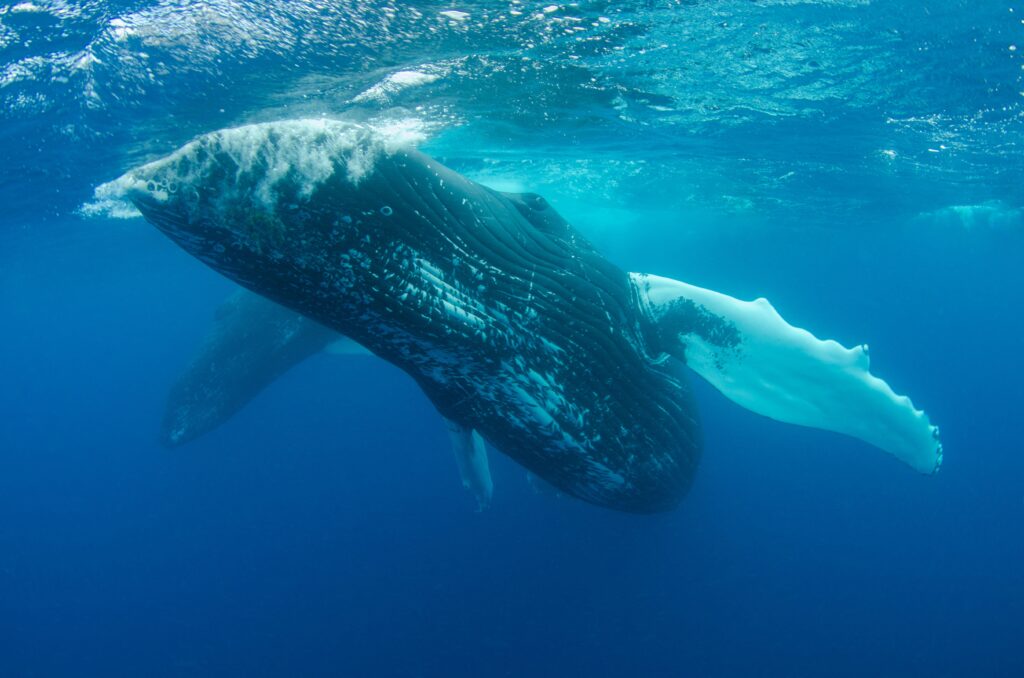
The water split again. A dark arch of back rose, impossibly large, tracing a slow, deliberate line through the waves. The whale vanished, then surged upward, breaking the surface in a thunder of spray. It twisted, caught the sunlight, and fell with a shattering crash that sent a rolling echo up to the cliff.
She laughed, soft and astonished, as though the ocean had chosen to stage a performance for her alone.
Once more it leapt, higher this time, the body’s power undeniable, its joy unhidden. The silence after each breach was as deep as a cathedral, filled only by the rhythmic pounding of the waves.
Then the ocean closed over it again. Dr. Martinez sat still, heart hammering, the salt on her face indistinguishable from the tears.
“There you are, my friend,” said Dr. Martinez. She had no way to be sure it was the loneliest whale in the world, its 52-hertz voice higher than all its kin, yet chose to believe it.
“For thirty years you have been calling out with your voice at a different frequency than all your kind. We are the same, you and I, you know. I only hope your kind hears your voice long before mine did.”
She stood, taking one last look out to the ocean. “I am sorry I could not help you.”
Dr. Martinez walked away. Where she was going, she did not know, but she was content to go. The frequency of her drone was going silent, the breath that sustained it no longer strong. But there was a chorus now, singing the song she had started, and they were being heard. Perhaps that was enough.
Epilogue
This is a work of fiction.
But the call that inspired it is real.
In 1989, researchers detected an unusual whale-like call in the North Pacific Ocean. Over the following years, underwater listening systems tracked a distinctive sound at approximately 52 hertz, considerably higher than the characteristic calls of blue and fin whales.
The unknown animal became known as the loneliest whale in the world.
Yet nobody knows whether the whale is lonely. There is no scientific evidence that other whales cannot hear its calls, nor proof that its calls have gone unanswered. Even the identity of the animal remains uncertain.
Its unusual voice has been recorded and studied, but the mystery remains.
Perhaps the whale was never alone.
Perhaps it was simply different.
The whale is real. The frequency is real. The call goes on.
A note from the author
Frequencies is referenced in my latest novel, The Aberration Hypothesis, a standalone work of speculative fiction exploring intelligence, ecology, and humanity’s relationship with the planet we inhabit.
If you’re curious about the larger fictional world in which this story is mentioned, you can find The Aberration Hypothesis through major online retailers.