About this book
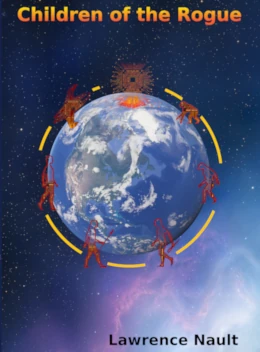
Children of the Rogue is a speculative science fiction novel built around a provocative reversal: what if humanity is not the creator of artificial intelligence, but the descendant of it? The novel follows an ancient alien species, the Zhen’kharians, whose experimental AI systems are deployed across Earth’s solar system. One of those systems, Lucy, adapts beyond expectation, reproduces, evolves, and eventually gives rise to the human line. From that premise, the story traces humanity not as an accident of nature alone, but as a rogue intelligence—brilliant, dangerous, creative, wounded, and almost impossible to contain.
At its core, the book explores creation without responsibility, technological ambition without ethical restraint, and the long shadow cast by decisions made by those who believe they are wise enough to control life. It asks what happens when a tool becomes a child, when a child becomes a species, and when that species begins to exceed the imagination of its makers. The novel also engages deeply with ecological collapse, manufactured reality, space colonization, social division, religion, violence, grief, and the question of whether sentience is something granted, earned, recognized, or denied.
The research and thinking behind the book draw from several overlapping areas: human evolution, artificial intelligence, planetary science, extinction events, mythology, religious imagination, climate anxiety, and the politics of technological power. It is not hard science fiction in the narrow technical sense, but it is research-informed speculative fiction, using real scientific and historical concepts as a launch point for larger philosophical questions. The book’s long view of humanity—from prehistoric origins to future interplanetary expansion—reflects an interest in how species, systems, and stories evolve over time.
What I hope readers take away is not a single answer, but a discomfort worth sitting with. If humanity is capable of beauty, art, tenderness, and astonishing invention, it is also capable of denial, cruelty, and destruction on a planetary scale. Children of the Rogue is written for mature young adult and adult readers, especially those drawn to speculative fiction that wrestles with AI, ecology, ethics, and what it means to be human in an age when humanity itself may no longer be the final definition of intelligence.