The MacIver Kids Adventures ·
Lawrence Nault · Middle School Science Fiction · Published 2023
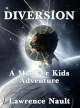
Lawrence Nault wrote Diversion to take a familiar adventure story and push it beyond Earth, using Europa and Atlantis to ask what happens when wonder is built on inequality. At its core, the book is about family, belonging, and the danger of societies that decide some people are more valuable than others. What makes it distinct is the way it blends space travel, alien contact, disability, found family, and social justice into a youth science fiction adventure.
I wrote Diversion because I wanted the MacIver kids’ next adventure to feel larger than the first, but not simply bigger in the usual science-fiction sense. Sending them to Europa, beneath the ice, gave me a way to combine real space science with one of humanity’s oldest myths: Atlantis. The research began with the Galileo mission, Europa’s hidden ocean, and the idea that even a fragment of human exploration could disturb a world we never knew was there.
But the heart of the book is not the technology or the distance from Earth. It is the question of what kind of society we build when we believe some people matter more than others. Atlantis is beautiful, advanced, and full of wonder, but it is also shaped by hierarchy, inheritance, discrimination, and fear. That contrast mattered to me. I wanted readers to see that a society can be brilliant and still be unjust.
The MacIver kids are adopted, blended, imperfect, stubborn, loyal, and stronger together than they are apart. Through them, the book looks at family as something built through love and choice, not bloodline or status. Brad’s connection to Atlantis lets the story challenge the idea that ancestry should decide anyone’s worth, while Allen’s presence keeps the book grounded in ability, courage, and the quiet strength of being seen fully.
I hope young readers come away from Diversion with a sense of wonder, but also with questions. Who gets included? Who gets hidden? Who decides what “perfect” means? The book is written for readers who love adventure, space travel, aliens, and impossible cities, but also for educators, librarians, and families looking for science fiction that opens the door to conversations about belonging, justice, disability, and what it really means to help.
Free downloadable guides for educators, librarians, and book clubs.
Diversion is best suited for Grades 7–12, with a reading level that bridges advanced middle grade and young adult audiences. Its strongest curriculum connections are in English Language Arts, Science, and Social Studies: students can study character development, plot structure, theme, symbolism, perspective, and world-building while also connecting the story to astronomy, Jupiter and Europa, physics of space travel and gravity, radiation biology, underwater ecosystems, engineering, and city systems. The guide also supports social studies discussions around cultural identity, political systems, social hierarchies, immigration/adaptation, gender roles, civil rights, leadership, power, and social justice, making the book useful for cross-curricular projects involving science modeling, ethics debates, cultural comparisons, government design, creative writing, and real-world connections.
Download PDFThe Diversion Book Club Discussion Guide includes pre-meeting preparation ideas, opening questions, and themed discussion prompts that help readers explore the novel’s blend of science fiction, family drama, and social commentary. It guides groups through topics such as family and belonging, power and society, love and sacrifice, technology and progress, gender and power, and the contrast between Earth and Atlantean culture. It also includes character-analysis prompts for Brad, Allen, Iris, Diana, Leonidis, and the MacIver sisters, along with sections on world-building, writing craft, future speculation, creative activities, refreshments, further reading, and tips for keeping discussion inclusive, flexible, and connected to real-world parallels.
Download PDF